
Budgets and Boycotts
Welcome to spooky season on the eve of the mayoral budget address and just days before the midterms. Things could always get worse, but for now, we are stable; as in the establishment is acting like they have everything under control, while the left flank of the Chicago political scene is fighting to get it together. The most direct way to un-confuse ourselves is to follow the money. As in who is gatekeeping progressive revenue for Chicago, our public schools and our communities.
First things first: Illinois is RICH, baby.
Here are just a few fast facts:
If Illinois was a country, it would rank 20th on the list of wealthiest countries in the world. With GDP at $1.24 trillion, Illinois would rank 20th, just below Saudi Arabia and above Switzerland, in other words in the Top 10% of richest countries in the world.
Illinois has the 5th largest economy in the United States, with a nominal Gross Domestic Product (GDP) of $1.24 trillion (approx. $1,240.9 billion).
Illinois ranks fifth nationally with 347,000 millionaire + households.
As of 2020, Illinois ranked fifth nationally with 347,000 millionaire + households.
Chicago is home to roughly 120,500 individual millionaires, placing it 4th among US cities for millionaire population.
Illinois hosts at least 18 individuals on the Forbes 400 list of Americas richest people. And that doesn’t include our Gov. JB Pritzker, who is not on the 2026 forbes 400 list because his wealth - $4.2B - is just below the Forbes 400 threshold at $4.4B.
Illinois is rich, but it makes the poor pay
Chicago’s Budget Challenges Start in Springfield - Structural deficits are the root cause of chronic underfunding that start at the state-level.
Income Tax: In 1970 the Illinois Constitution was amended and established a flat tax rate of 4.95% - so the lowest earners and highest earners pay the same income tax rate. From 1979 to 2022, the top 1% of earners saw their income increase 325% ($501k to $2.133 million) while the bottom 20% saw their income increase only 30.5% ($62,734 to $81,845)
Sales Tax: Currently, Illinois only taxes 29 of 176 consumer goods and services categories while the national average is 58. Those 29 are heavily skewed towards goods even though service-related transactions now account for 73% of Illinois GDP. And Illinois is one of only 12 states that taxes groceries. As a result, the state general fund sales tax revenue in FY2027 is $1.1 billion less than FY2000, adjusted for inflation.
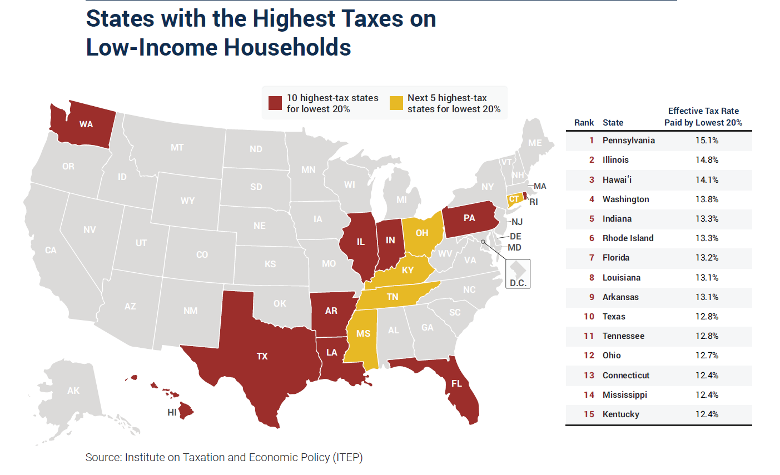
Illinois has the eighth most regressive state and local tax structure in the country with the lowest 20% of earners in the state – less than $26,700 annually – paying 14.8% of their income in state and local taxes while the top 1% of earners in the state – over $749,400 annually - paying 7.3%; less than half of the rate of the lowest income residents. Overall, the lowest 20% of earners in Illinois pay the second highest state and local tax rate in the country.
Together, neither the income tax or sales tax structure provides a basis for even maintaining status quo against the normal inflationary pressures that increase the cost of delivering the same level of services to residents.
Wait, what about Chicago?
The Illinois Constitution also prohibits “home rule” municipalities with a population over 25,000 – like Chicago – from levying taxes based on “income, earnings or occupation” unless the state General Assembly specifically passes a law allowing it; something the General Assembly has never done.
Chicago’s budget building efforts start in a system that has failed to build a tax system that relates to the reality of the 21st Century economic landscape let alone anything that resembles a progressive tax structure.
There are number of other factors that contribute to the budget crisis, which we will unpack in a separate budget explainer. Here are some highlights:
The Trump Administration’s One Big Beautiful Bill (OBBB) has made the situation in Illinois demonstrably worse: over the next 10 years, the OBBB is projected to reduce funding to Illinois’ General Fund to the tune of nearly $100 billion.
Historic underfunding of pension funds Increasingly contribute to fiscal challenges.
Together – a state-level broken tax system and a pension fiscal mill stone – these forces have created an almost impossible situation for municipalities and school districts across the state.
This historic underfunding from the state has resulted in the City of Chicago and Chicago Public Schools in particular relying increasingly on property taxes to cover the gap between constrained revenue and the services it needs to provide to residents and students, respectively.
Both the City of Chicago and Chicago Public Schools are significantly constrained on how and where they can grow revenue.
What about Chicago Public Schools?
Illinois has the 6th highest proportion of public education funding coming from local sources, which drives up property taxes statewide. as a result, Illinois has the second highest property tax rate in the US. This is a statewide issue, not just Chicago Public Schools. The 2026/27 funding gap to Chicago Public Schools from the state of Illinois, based on the state’s failure to follow with its own evidence based formula is $734M for this school year. This is the third year in a row that the state has decreased the target funding, now ~below 73% vs the original 81%, with the cumulative budget gap reaching $1.6 billion.
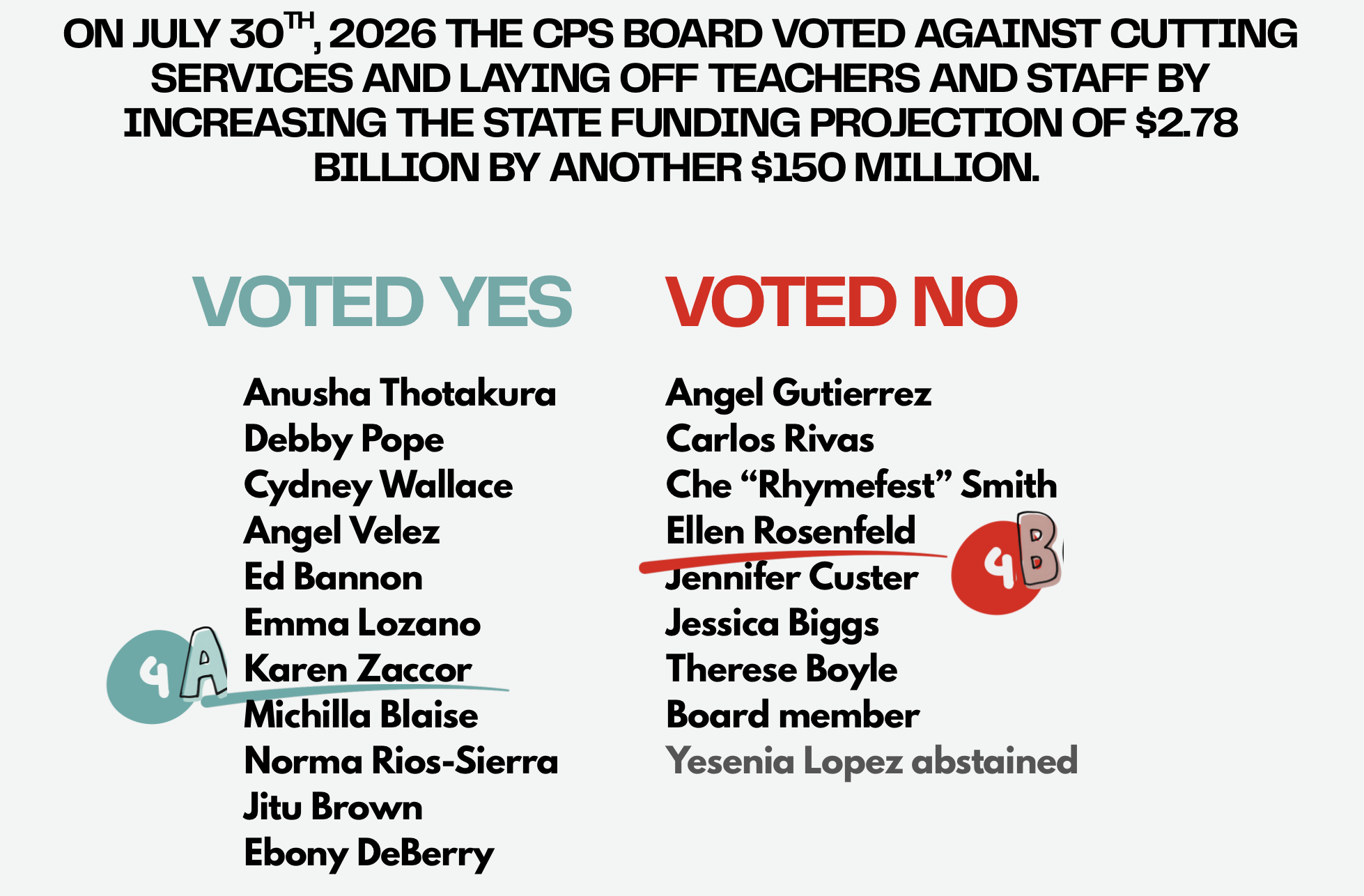
The CPS Board is drawing attention to the urgent and systemic failure of the state of illinois to FULFILL its own mandate to fund public schools in Chicago and across the state. On July 30th, 2026 the CPS board voted against cutting services and laying off teachers and staff by increasing the state funding projection of $2.78 billion by another $150 million.
The reaction against the board members who voted Yes was swift. Common Ground Collective and other corporate privatization PACs are throwing millions behind the candidates running against the school board members who stood up to the systemic inequity and defunding of our public education. As we are heading into the midterms, with state and federal offices having been decided during March primaries, our school board representatives and school board president are the only races that matter.
The Chicago vs. Illinois Dilemma
Since the state doesn’t raise progressive revenue, and municipalities are not allowed to do so by law, where does this leave us?
In the next days and weeks, following the release of the city of Chicago budget, the corporate propaganda campaign will be unleashed. Common Ground Collective, One Future Illinois and the like will try to distract us with rage-bate and theatrics. You will see the same CGC, OFI, and other made up names/abbreviations in ads telling you that CPS, CTU, the Mayor are bankrupting the city and taking advantage of you, the little guy. We are already seeing these Reagan-coded talking points coming out of full-time mayoral candidate and part-time US Congressman Mike Quigley, with his home-spun wisdom of “my Daddy taught me to stretch the dollar” routine. “Reform before revenue” misses the basic point that in order to reform or renovate our outdated bureaucratic systems and processes, we need revenue to pay for the upgrades.
Any candidate, politician or influencer that tells you that our problem is that we spend too much, is confused or lying. Our problem is that we have an outdated, regressive tax system that disproportionately taxes the poor and lets the rich and corporations off the hook against the backdrop of inflation and economic crisis.
Which brings us to the other side of the fight over revenues and basic economic and moral justice in Illinois: the questions and protests against our state investments in Israel bonds and the anti-BDS law repeal are getting louder, as we are heading into November Springfield session.
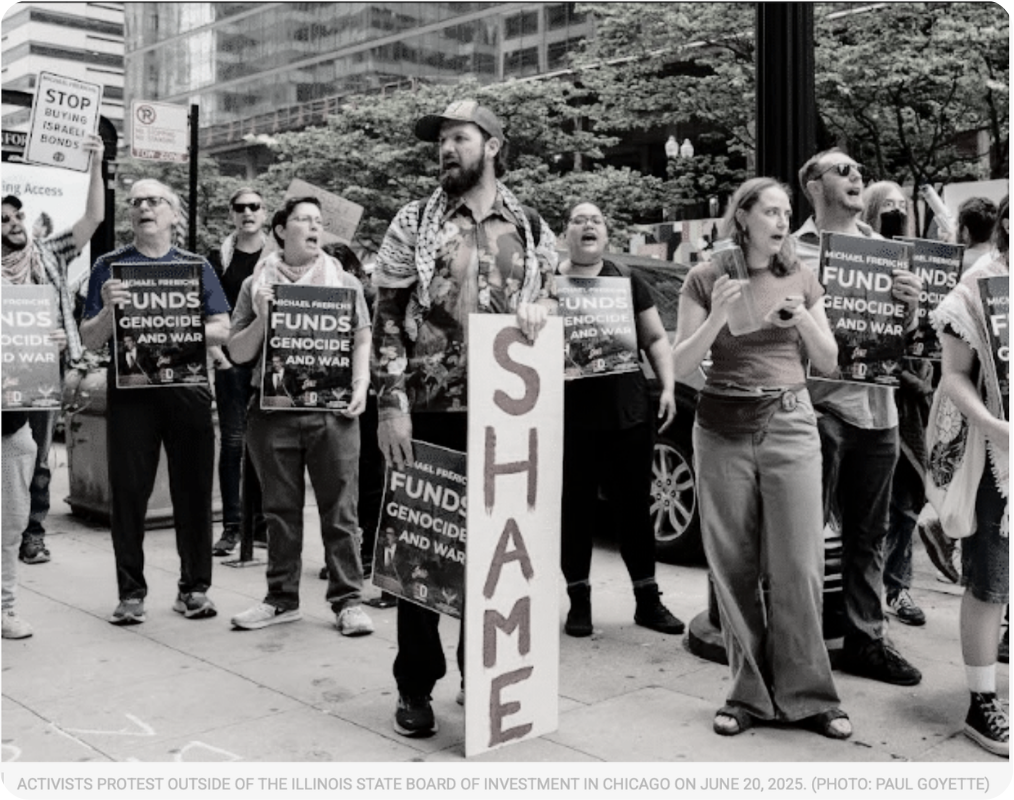
A growing movement is calling on Illinois to divest $100 million of Israel Bonds, and has filed an ethics complaint against Treasurer Michael Frerichs, alleging abuse of authority, corruption, improper use of state time, and misuse of public assets.

Perhaps you will not be surprised to learn that Illinois State Treasurer Michael Frerichs also lives in our ward. When he is not busy doubling down on his position to invest in Israel bonds, he enjoys spending time with our alderman Lawson and our state senator Feigenholtz, as both of them noted in their recent newsletters. The same newsletters that show our entire local elected slate standing outside with signs to save the beautiful Lincoln Park neighborhood from the unseemly ComEd substation on Diversey.
The Diversey substation issue that should be solved by using the official power of our state representatives, state senator and our local alders, instead is being turned into a performative activism circus with the help of the local Indivisible chapter, also home to Paul Kendrick, who is counting days to replace current HD12 rep and all but official state comptroller Margaret Croke.
Our state senator Feigenholtz has been in the business of state government for over 30 years. She knows exactly what should be done. Instead, she is creating a diversion from all the substantive issues that she and her state rep colleagues should be working on, such as repealing the shameful anti-BDS law that she introduced and passed in 2015, fixing our regressive tax system with its systemic underfunding of municipalities and public schools, or at the very least, following basic democratic norms, such as holding public meetings in her district.
What can you do?
With the municipal elections, city of Chicago budget, and Springfield November session happening all at once, there are a few things we could be doing rights now:
Nov 3 Elections! Copy and share our cheat sheet.
Donate, volunteer and vote for our public schools champions:
Hilario Dominguez for School Board President
Karen Zaccor - 4A
If you live in the 4B section of our ward, our current unchallenged board rep is Ellen Rosenfeld. We don’t have enough space here to go into all the details of her inglorious tenure on the CPS board; we just leave her blank for now.
If you are not sure which school board district you are in, public schools champions site has all the details.
Chicago City Budget + ongoing city council actions
We will be publishing more details and actions in the next days and weeks. In the meantime, join budget actions here. And always, always, be calling our Alderman Lawson to remind him to vote for People over Profits when it comes to Chicago’s budget, support renter’s rights (PRO vote has moved to November 18th), and support the Fair Elections ordinance.
Wait! What about State Stuff?
Didn’t we just learn that the biggest gap in funding comes from Springfield? Why are we only talking about the Chicago school board and Chicago city budget? Excellent point!
Reach out to your state reps and state senator to tell them that: their job#1 is to fund our schools and our communities BY RAISING PROGRESSIVE REVENUE! We expect them back in Springfield in November ready to deliver. And, while you’re there remind, them to join the repeal of the anti-BDS law and stop Illinois state investments into Israel bonds.
4. Join our Anti-BDS repeal action here.
The easiest way to join is to sign the IHRC petition, which will send the email to both our state rep and state senator. They will be charmed, we’re sure.